Disclosure: I’m not a financial advisor. This isn’t financial advice — just what worked for our family. Your financial journey is yours to chart.
Living off your investments sounds fun until the market dips and all of a sudden you're eating beans and rice in Ibiza and calling it geoarbitrage. 🫘🌎😅

JK, JK.. Ok, by this point, we’d executed our decade-long plan to FI. We kept up our savings rate, invested the extra $$$, and tried to live our ‘why’ along the way. We finally made it to FI! The next step was to actually retire early but first, we had to figure out how to efficiently withdraw our money.
Retiring early flips your whole money mindset. You spend years stockpiling cash and compounding returns, and then suddenly the name of the game is withdrawals. No more paychecks, just your portfolio footing the bill.
It’s unsettling at first. I had a brief panic spiral thinking, “maybe we should only spend 3%?” But we came back to our plan and, more importantly, our ‘why’. We built this life so we could live it, so we shouldn’t hold back now.
Here’s how we’re managing our money now that we’re officially post-paycheck—keeping it as simple as possible.
The 4% rule in action
Recall: the 4% rule. The rule says if we withdraw 4% of our portfolio in the first year and adjust that number for inflation each year, we’ve got a very high probability our money lasts 30+ years. That 4% is what we used to calculate our FI number (25 × our annual expenses).
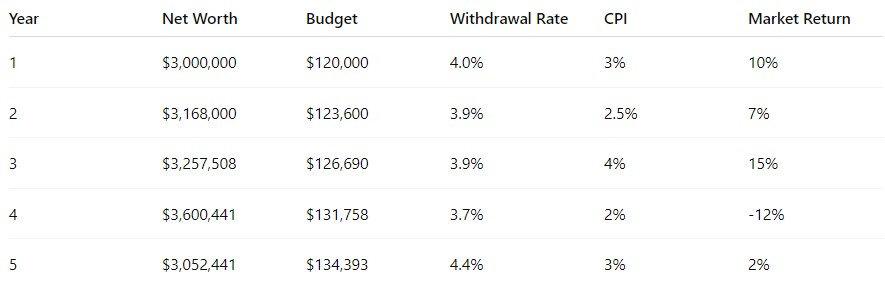
For example, our budget in Year 1 of retirement:
- Net worth: $3M
- 4% withdrawal: $120k
- Inflation (3%): Next year’s budget = $124k (better use that extra $4k wisely! lol)
And so on. See a 5-year example below:
Quick note on the annual budget, we adjusted it to reflect our new retirement lifestyle:
- Childcare costs dropped significantly.
- Most of our travel expenses just become regular life now (since we’re going full nomadic).
- We’ll be paying for global health insurance ($5k/year).
Reducing risk: our updated asset allocation
Right before we retired, we made our portfolio a little more conservative. We moved to 90% equities and 10% bonds & cash.
This is a common move among retirees. Capital preservation became way more important as we neared the edge of quitting work. High-quality, short-to-intermediate term US bonds give us safe, predictable, but lower returns.
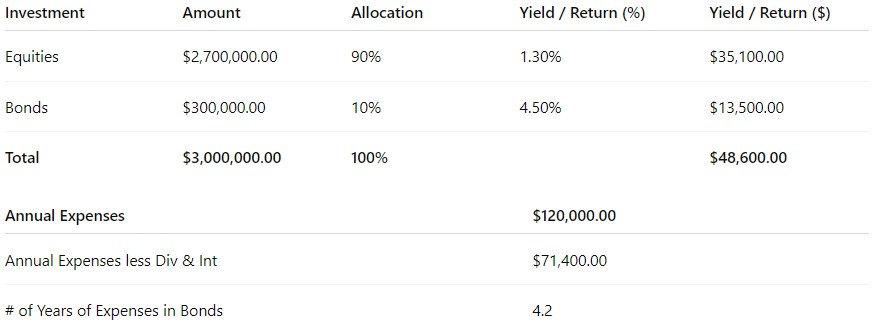
Recessions usually last about 2 years, followed by a 3-year recovery. That’s 5 years where the market’s messing around. Our 10% in bonds covers about 4 years of expenses in low-risk, low-volatility assets (see table above), giving us a buffer to ride out downturns without having to sell equities.
That’s how we protect against sequence of returns risk—the danger of pulling money out during a market crash, which can seriously damage a portfolio’s ability to recover. This risk is most critical in the first 5 years of retirement.
Our mindset shifted: now that we’re at FI, it doesn’t make sense to chase max returns if it means risking the whole plan. We’re okay leaving a little on the table (maybe 0.5%) in exchange for stability. Preserve capital and, as my SIL says, be #BlessedNotStressed.
Our 4-bucket withdrawal system
Now we'll go into detail on how we actually withdraw money from our investments. Continuing our example, we split our assets into 4 buckets to balance risk, returns, and liquidity:
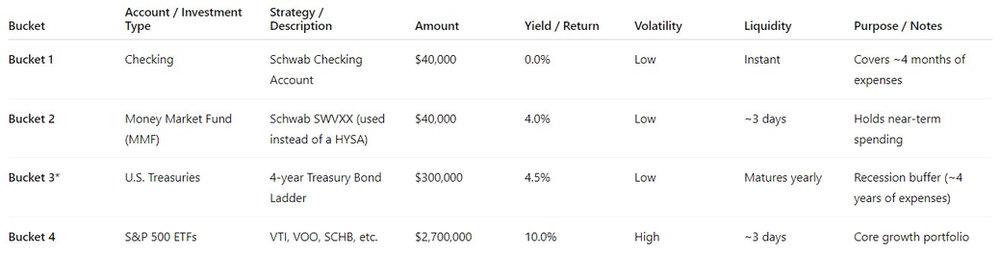
*Bucket 3: I built a multi-year bond ladder using actual U.S. Treasury bonds—in our case, a 4-year ladder. I’ll break down how we set this up in a future post.
How it works:
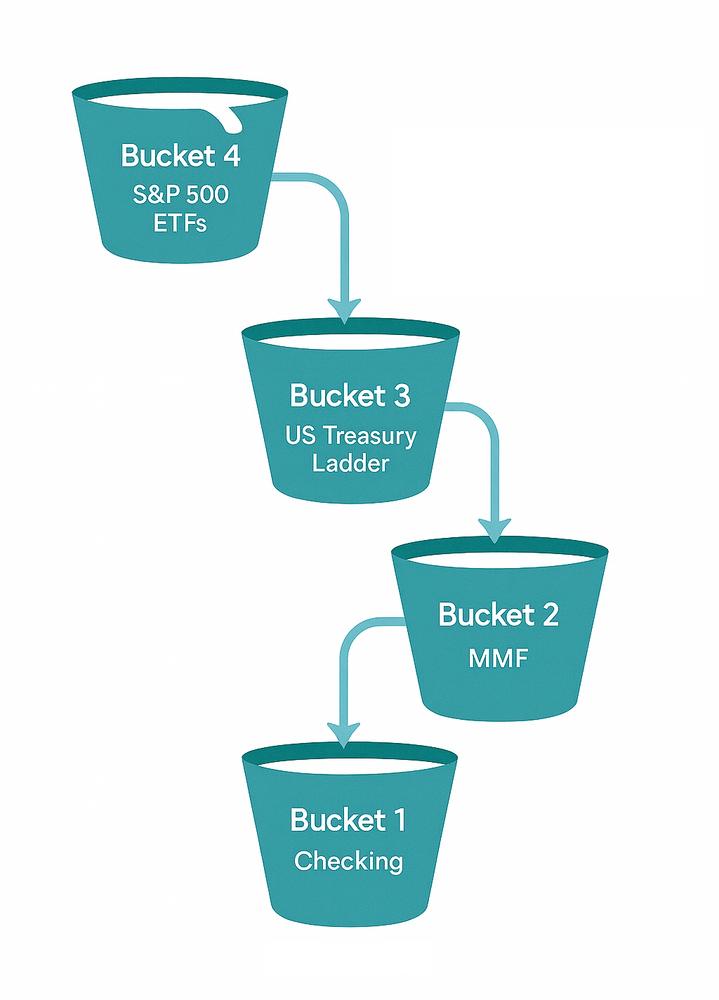
- Bucket 1: Day-to-day spending. Credit card payments and ATM cash come from here.
- Bucket 2: When Bucket 1 gets low, I top it off from here.
- Bucket 3: Each year, a bond matures. I refill Bucket 2 with this cash (~1 year’s of expenses).
- Bucket 4:
- I move quarterly dividends from Bucket 4 to Bucket 2, ready for spending.
- If the market’s up that year, I’ll sell a year’s worth of expenses (adjusted for inflation) from here and use the proceeds to buy a new U.S. Treasury bond, adding it to the end of our bond ladder in Bucket 3. That resets the ladder back to 4 years and keeps our recession buffer intact.
- If the market’s down, I won’t touch our equities. Instead, we’ll live off the bonds in Bucket 3—avoiding selling stocks at a loss and reducing sequence of returns risk.
I don’t have to do much to keep this running. I usually move money around every few months.
Simple. Low touch. Sustainable.
Minimizing taxes in early retirement
Interest, dividends, and capital gains all trigger taxes. But with a little strategy we’re aiming to pay zero taxes in early retirement. (We don’t have state taxes.)
Not all income is taxed equally
Understanding how each type of income is taxed and how to play the tax brackets is the game:
- Interest and short-term capital gains → taxed as ordinary income = bad
- Long-term (LT) capital gains and qualified dividends → taxed at lower rates, and sometimes even 0% = good
Here’s a quick look at the 2025 federal ordinary income tax brackets for married filing jointly:
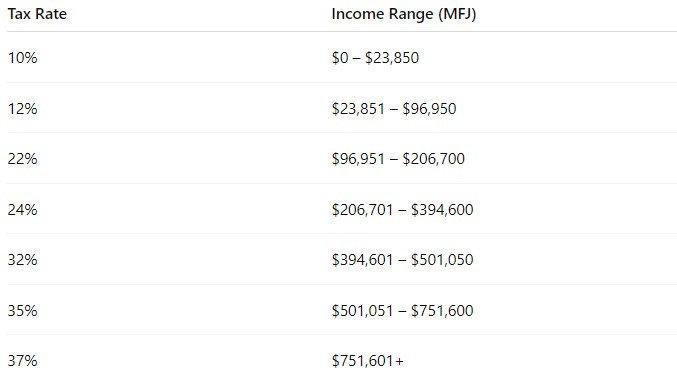
Now compare that to the 2025 LT capital gains tax brackets for married filing jointly:

The biggest difference is that the first ~$96k of income isn’t taxed under the LT capital gains bracket.
How we take advantage of this
We aim to move as much of our income as possible into the LT cap gains bucket. The easiest way to do this is to pick funds that throw off qualified dividends and sell stock that we’ve been holding for more than 1 year (long-term stock).
Next, we stack up some pretty basic deductions and credits:
- Standard deduction: $31,500 (married filing jointly)
- Child tax credit (CTC): $2,200 per child → for us, that’s $6,600
Real-world example: $0 taxes on $48,600 in income
Continuing the example we started earlier with our 90/10 portfolio where we would have $48,600 in income.
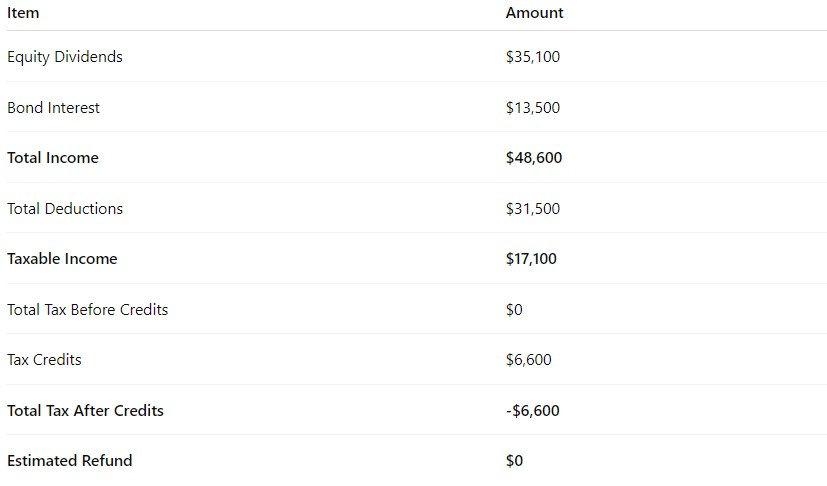
The bond interest is taxed as ordinary income, but it’s fully canceled out by the standard deduction. Part of our dividends are canceled out by what’s left of that deduction, and the rest are qualified dividends, which fall under the LT cap gains bracket and are taxed at 0% up to $96,700. That means we owe $0 in federal taxes on nearly $50k of income. Not bad for early retirement. But, we are leaving money on the table by not using the CTC and I ain't trying to live off $50k.
Bonus round: $172K in income, $0 in taxes 🤯
We run a more advanced version of this when we sell equities to re-up our bond ladder (Bucket 3). That sale triggers long-term capital gains. Building on the previous example, here’s how we fully use the LT cap gains bracket and the CTC:
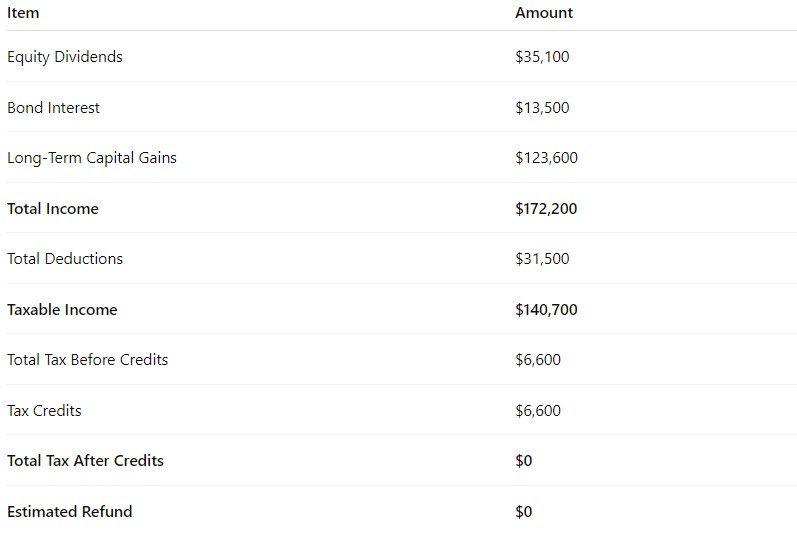
Most of the LT capital gains fall into the 0% bracket. Whatever spills over is offset by our CTCs. Final result? We owe $0 in federal taxes on $172K in income. That’s a quick look on how we use the different tax brackets and deductions to minimize taxes.
The Fear of Running Out (FORO™)
Pretty sure I just made that up.
Even with a solid plan, the idea of draining our portfolio—whether from overspending or a market downturn—is scary. FORO is real. So instead of working longer or saving more, we will perform the following actions to protect against both overspending and big market dips:
- Cut expenses: Being nomadic helps. No mortgage, no car payments. But even if we weren’t, we’d cut back where we could and downsize if needed.
- Geoarbitrage: Cost of living changes a lot depending on where you are. A few months in Thailand or Mexico can extend our budget while giving our portfolio time to recoup.
- Pick up work: We could work part-time, take contract gigs, or try something new like being a barista or doing DoorDash, lol.
These are all short-term levers. Once markets bounce back, compounding kicks in, and we’re back at FI (25 × our annual expenses), we can ease off. That’s the beauty of early retirement—we’re still young(ish), healthy, and flexible. And flexibility is the real safety net. The ultimate fallback is we just go back to our old life, and that ain’t bad. #YOLO
Well, there it is. That’s how we manage our money after FI. While our strategy isn’t perfect, it’s simple, flexible, and works for our family.
Want to go deeper? Below are some good reads:
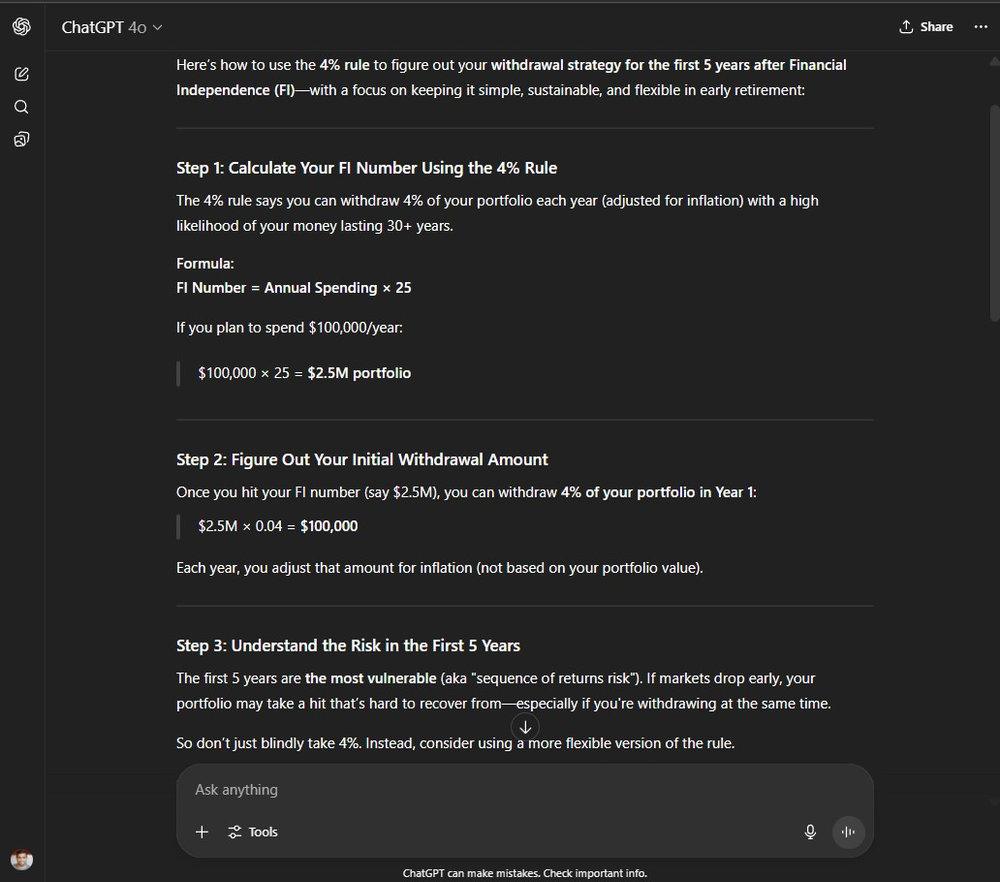
AI epilogue:
Figuring out a withdrawal strategy that worked for us took some research. While we brainstormed with friends and pros, we also brainstormed with AI.
Prompt:
How do I use the 4% rule to figure out my withdrawal strategy for the first 5 years after FI?